Shitgibbon: the saga continues

My campaign to have “shitgibbon” declared the Oxford Dictionaries Word of the Year 2017 is gaining momentum with a ground-breaking revelation in the search for the term’s origin.

Ben Zimmer reports that this delightful word was coined by the British writer David Quantick.

“I’m surprised and delighted that a word I made up in the 1980s to insult British indie rock stars has resurfaced in the context of 21st century US politics and the shitgibbon in the White House,” Quantick told Zimmer. “It’s bizarre and a very odd journey for a very silly word.”

From the irksome Mark E. Smith to a strange-haired delusionist strongman is indeed an odd journey. Let’s hope the Oxford folks are listening.

(By the way, I’m following Zimmer’s practice and dropping the hyphen from “shitgibbon.” As the Canadian Press Stylebook notes, “in North America, the tendency is to drop the hyphen as soon as a new compound becomes familiar.” I say it’s time we all got familiar with this exemplary bit of invective.)

After Several Fails, Should We Trust Election Polls?

It’s a key question, given the swarm of public opinion reports on the horizon.
By Tom Barrett
TheTyee.ca

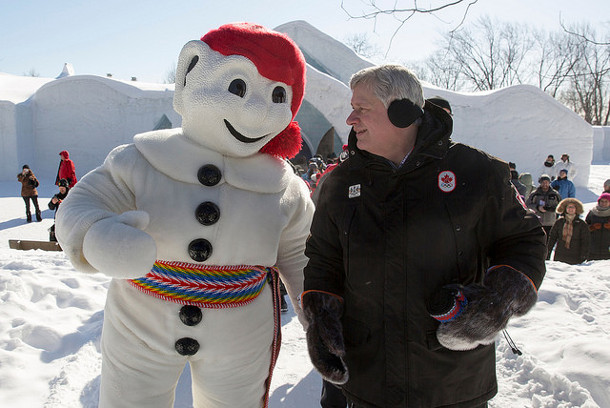
One academic cautions that election polls tend to underestimate support for the incumbent party. Photo of Prime Minister Stephen Harper with Bonhomme by pmwebphotos Flickr.

In recent weeks, pollsters have asked us questions about UFOs, cyberscams, the coming federal election and Metro Vancouver’s transit plebiscite. But there’s one question many of us are asking the pollsters: Why should we believe you?

The 2013 B.C. election fail did for the polling industry what the Hindenburg did for the dirigible as the last word in air safety. Since then, pollsters have been struggling to find ways to better measure what we’re thinking.

For pollsters, there’s no money in asking questions about elections and releasing the numbers to the media. They do it as a marketing tool to attract clients who want to know what people think about, say, shampoo.

Because the numbers in marketing surveys are difficult to verify, calling elections correctly is one of the few ways pollsters can show they know their stuff. Calling elections correctly, however, is becoming increasingly difficult. And bum results don’t attract clients.

University of British Columbia political science professor Richard Johnston said he understands their plight. “If I were in the firms I would almost ask myself, ‘Is it worth it to be in the prediction business?'” he said.

But if pollsters quit doing public polls, voters are left with less information, said Johnston. Voters have a valid interest in knowing how their fellow citizens are going to vote because it allows them to decide how to vote most effectively, he said. “If you can’t make sense of the polling information, then what do you do?” Continue reading

A word I just learned…

… reading World Wide Words:

Logocidal

“Logocidal refers to the destruction or perversion of meaning, something deadly to reason and communication,” says Michael Quinion. “Newspeak in George Orwell’s Nineteen Eighty-Four was a logocidal creation since it was designed to limit what it was possible to think about or discuss.”

It’s another word that’s obscure almost to the point of nonexistence, but Guardian writer Marina Hyde appears to be fighting a single-handed battle to keep it alive. “She uses it for language that’s obfuscatory to the point of meaninglessness, the kind employed by politicians and public figures to avoid committing themselves…” says Quinion. A useful term, given the continuing epidemic of such banana oil.

A word I just learned…

… reading World Wide Words:

chloephobia

“…a fear of newspapers.”

And, yes, there does seem to be a lot of it going around these days.


Polls ‘don’t predict the future’

And more hard truths about the use and abuse of modern opinion research.
By Tom Barrett
TheTyee.ca

Image: Shutterstock.

Election polls are fun. They can help you understand why politicians do and say the things they do. They can help you decide how to vote. And as long as the parties have access to polling, you should too.

But, as campaign polls proliferate like dandelions in April, they also become the source of a vast amount of the hooey that gets spewed by pundits.

Pollster Bob Penner has a long history of working for election campaigns. In a recent interview, he said the “literacy around polling” is pretty low.

Polling numbers naturally bounce around within their margin of error. “If you do the same method day after day, each day [the result] will be different,” said Penner, president and CEO of Stratcom. “That’s called sampling error.”

But if a pollster goes on TV and says the bouncing numbers are just sampling error, “he wouldn’t be on TV,” Penner said.

“So he’s got to construct a reason for why the numbers moved other than the probable real reason, which is just a natural variation in the polling method. So he says it’s because of the ads they ran today. Or it’s because of the media story that was on last night. Or it’s because this guy endorsed him. And that’s almost never true. It’s almost never the reason.

“But they’re out there saying it and people are at home consuming it and saying, ‘well, those ads really moved the numbers.’ ”

Continue reading

Canadian Online Publishing Awards

Congratulations to the Tyee, which has been nominated for seven Canadian Online Publishing Awards.

The nominations include a project I worked on for the Tyee Solutions Society with reporters Christopher Pollon and Geoff Dembicki, editor Chris Wood, TSS director
Michelle Hoar and TSS acting director Fen Hsiao. B.C.’s Quest for Carbon Neutrality looked at British Columbia’s climate change policies four years after former premier Gordon Campbell launched one of the most ambitious climate strategies anywhere.

In the online awards “green division” (daily and weekly newspapers and broadcasters), the Toronto Star was nominated 14 times and the CBC 10. The Globe and Mail has eight nominations and the Huffington Post, the Grid and The Tyee each have seven.

The Tyee story about the nominations is here. And there’s a full list of the nominations here.

‘Omit needless words! Omit needless words! Omit…’

My favourite writing coach, Roy Peter Clark, has written a splendid tribute to William Zinsser, author of On Writing Well.

Zinsser’s best-known book is now in its 30th anniversary edition, having sold more than a million copies. Seeing as it’s probably the best book on writing nonfiction, that’s nice to know.

Writing on Poynter.org, Clark celebrates two pages of On Writing Well that reproduce a marked-up draft of the book.

For the record, they are pages 10 and 11 in my edition. I’ve studied them until my eyes bleed. I’ve shared them with countless aspiring writers, young and old. There have never — I say never! — been two pages in a writing text as practical, persuasive and revealing as pages 10 and 11. Like the music ethos articulated by the likes of Miles Davis and Tony Bennett, Zinsser demonstrates in writing that there are notes in a composition (words in his case) that the artist should leave out.

Pages 10 and 11 show how Zinsser slashed words and phrases that most of us would lazily let stand. The result is tighter, clearer and more powerful. “Faced with such a variety of obstacles” becomes “faced with these obstacles.” “He tends to blame himself” becomes “He blames himself.” “Two or three different” becomes “several.”

As Zinsser says, “rewriting is the essence of writing.”

The man with no name meets the chair with no man

The great thing about being a pundit is you get to have it both ways. As the Republican National Convention geared up a few days ago, the media were grousing that the show would be a “hyper-scripted” and pre-packaged ritual that would offer nothing in the way of spontaneity.

Then Clint Eastwood had his Howard Beale moment with the vacant chair. And the media got all grumpy, complaining just because his unscripted kook-out was “bizarre,” “weird” and “rambling and off-color.”

It was, of course, all of those things. That’s what happens when you throw away the script. Savour it. Thanks to Clint, that kind of political improv probably won’t ever be seen again.

A tragedy misreported and misremembered: Why ‘the killer is rarely who he seems’

Dave Cullen was one of the reporters who descended on Columbine High School in 1999 when two teenage boys began murdering their classmates. Like the rest of the media pack, he reported a lot of things that simply weren’t true.

Unlike the other reporters, Dave Cullen kept going back to the Columbine story until, a decade later, he had learned what really happened.

On Sunday, as another pack of reporters swarmed the scene of another Colorado shooting, Cullen wrote in the New York Times about the myths that he and his colleagues created more than a decade ago. We think we know the Columbine story:  two teenage loners, bullied by jocks until they sought revenge.

“Not one bit of that turned out to be true,” Cullen wrote in the Times.

The media created myths about Columbine and “we created those myths for one reason,” Cullen writes. “We were trying to answer the burning question of why, and we were trying to answer it way too soon.”

What is really disturbing for the media, and for anyone who relies on the media to understand the world, is the way those myths were created. As Cullen makes clear in his excellent book, Columbine, the early media reports were part of a feedback loop that started with media speculation.

When the reporters arrived at Columbine High, witnesses told them what they wanted to hear: stories about loners and bullying jocks. It wasn’t because the witnesses had first-hand experience with these “facts.” They were just passing on what they’d heard in the very first radio reports, which had been based on speculation, based on myths and stereotypes.

The front page of my Globe and Mail today has an indication of how powerful these loner myths are. A Top Student, a ‘Weird’ Loner, reads the headline on my print copy of the paper today. No matter that no one in the story calls him a loner; in fact, the story has a line from the AP quoting an acquaintance of the Aurora killer, who says that “describing Mr. Holmes as a ‘loner’ would be unfair.” (The online version has a more accurate head that still plays into our need for stereotypes about killers: Colorado Suspect a Top Student, but Too ‘Weird’ to Be Allowed on Shooting Range”)

Cullen urges his readers in the Times to be wary of news accounts about Aurora.

“Over the next several days, you will be hit with all sorts of evidence fragments suggesting one motive or another. Don’t believe any one detail. Mr. Holmes has already been described as a loner. Proceed with caution on that. Nearly every shooter gets tagged with that label, because the public is convinced that that’s the profile, and people barely acquainted with the gunman parrot it back to every journalist they encounter.”

The sad thing is that, despite Cullen’s excellent reporting, our impression of what happened at Columbine is still largely wrong. The myths of Columbine made sense and they made us feel better. So when Cullen came along with the truth – more complicated and more unsettling than the myth – we weren’t listening.